Your child's first phone: what to talk about before you hand it over
Before your child's first phone arrives, the most useful work happens in conversation: explaining how apps hold on to their attention, what never gets shared online, and who to turn to if something goes wrong. The settings and a few family rules come next, ready before the phone is in their hand.
Most first phone guides start with which handset to buy. I would start with what you say on the way home from school, a week before the box is opened.
Is now really the right time for a first phone?
There is no single right answer. Official guidance in France, which I use as a reference with the families I work with, suggests a phone without internet first, for example when children start secondary school around 11, and a connected smartphone around 13 (French Ministry of Health, updated March 2026). In Morocco, where I live and work, a Kaspersky and CMRPI study of around 1,000 parents found that 18% of children get their first personal smartphone before the age of 10 (Le Matin, 17 September 2026).
Age alone is not enough to decide. A guide from CLEMI, France's centre for media literacy, suggests a few simple questions instead. Does your child look after their things? Do they keep their commitments? Do they tell you when something is wrong, or do they prefer to hide their problems? (CLEMI, May 2026)
Look at the real need too. A child who walks home alone after football practice does not need the same thing as a child who is always picked up.
Which phone should you choose for a first phone?
You have three broad options:
- a basic phone that calls and texts, with no internet: this is the first step the French guidance suggests;
- a shared family smartphone, used at agreed times;
- a personal smartphone, with settings adapted to their age.
Starting simple and widening access as they show they can manage it gives your child independence in stages. They earn new freedoms instead of losing them, which changes the whole tone of the conversation at home.
Get them ready by playing: 20+ games to understand how apps capture their attention.Try lesson 1 free with my child →
What should you tell your child before giving them a phone?
This is the part that buying guides tend to skip. A well configured phone does not teach a child how to react. Here are five conversations to have before you hand it over, at a calm moment, in the car for instance, or on a walk.
- "Apps are built to keep you." Autoplay, endless scroll, notifications, streaks you don't want to break: none of it is there by accident. If your child can recognise these tricks, they can choose instead of being pulled along.
- "What's private stays private." Their address, their school, their photos and their passwords are not for sharing. One question helps them think: "Would you be comfortable if your teacher saw this?"
- "A stranger is still a stranger, even a friendly one." Act out the scene: "Someone you don't know messages you and asks for a photo. What do you do?" Look for the answers together.
- "If something scares you, come to me first." Tell them clearly that they will not be punished for telling you about a problem. That promise is what makes a child come to you on the day they need to.
- "At night, the phone sleeps somewhere else." Messages can wait until the morning. Real friends understand.
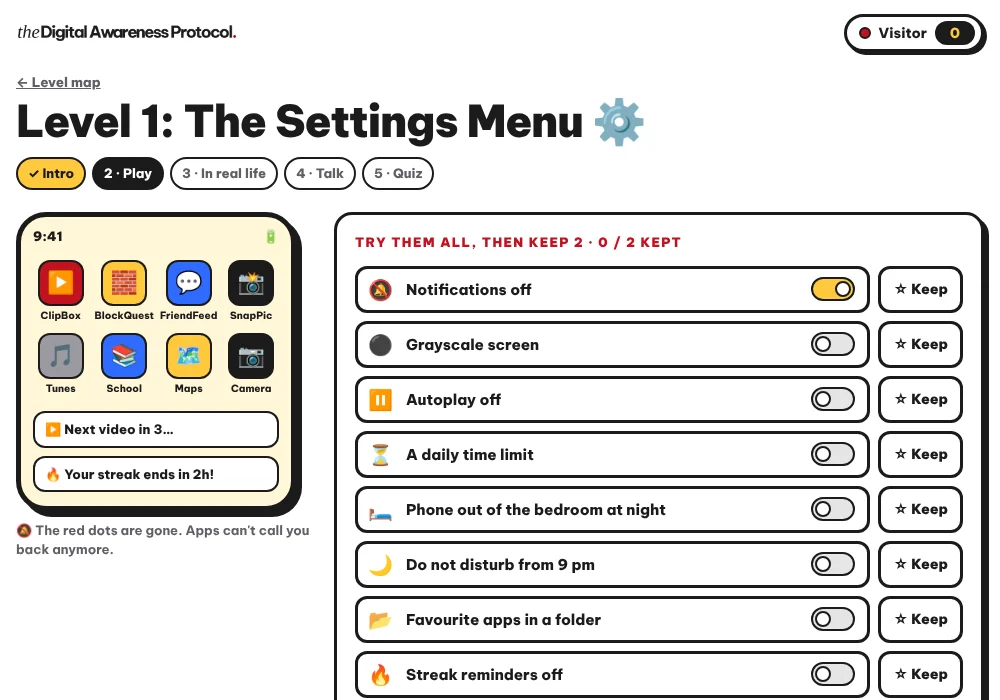
In sessions, parents often tell me the first conversation is the hardest, because they are not sure how the tricks work themselves. These talks get much easier when the child has already handled the mechanisms. That is the idea behind My Digital Awareness: in more than 20 games, your child finds out how apps capture their attention, what they are really looking for in their favourite app, and the right moves if something serious happens online.
Which settings should you sort out before handing over the phone?
Phones come with free built-in tools. The CLEMI guide recommends setting them up before the device changes hands: Screen Time on iPhone or Digital Wellbeing on Android, time limits for certain apps, and a "downtime" period when the phone has limited access.
- On iPhone, Family Sharing and Screen Time let you manage the apps and content your child can access, who they communicate with and when they use their device (Apple Support).
- On Android, the Family Link app lets you create a Google Account for your child and set screen time limits on their device (Google Help).
Add three simple habits: switch off the notifications that serve no purpose, keep the most absorbing apps off the home screen, and buy a cheap alarm clock so the phone can charge outside the bedroom.
Above all, explain each setting on the day you give them the phone. A setting that has been explained feels like protection. A setting discovered by accident feels like surveillance.
How do you write the family rules together?
A short family agreement, written with your child, works better than a long list of bans. It can fit on one page:
- where and when: no phone at the dinner table, during homework, or in the bedroom at night;
- how long: a time budget they suggest and you adjust together;
- safety: what we don't share, and who to turn to if there is a problem;
- the practical side: what happens if the phone is lost or broken?
- your own commitments: for example, not looking at your phone when they are talking to you.
Set a date to review the agreement, a month later for instance. If they have kept their side, they get a little more freedom. Whether the phone arrives for a birthday or the holidays, having this page ready beforehand makes the first evening much calmer.
And afterwards, how do you keep the conversation going?
The first few weeks count for a lot. Take ten minutes each week to look at their usage together, without judging. CLEMI suggests open questions: "What do you think about the time you spend on your phone? What was hard to manage this week? Did you see anything online that made you uncomfortable?"
If a rule gets broken, don't take the phone away in the heat of the moment. Talk about it once everyone has calmed down, adjust the rule if needed, and start again.
To see what the workshops look like before you create your child's space, you can try a game for free.
FAQ
What is the right age for a first phone?
French official guidance suggests a phone without internet first, around the start of secondary school, and a connected smartphone around 13. Your child's maturity matters as much as their age: do they keep their commitments, and do they talk to you when something is wrong?
Should you put parental controls on a child's first phone?
Yes, the built-in tools (Screen Time on iPhone, Family Link on Android) are useful for a first phone. Explain them to your child rather than installing them in secret, and plan to loosen them as they grow up.
What if they want social media straight away?
French guidance recommends waiting until 15 for social media. Offer an in-between step, such as a messaging app limited to friends and family they know, and agree together on what they need to show before going further.
Can they keep their phone in their bedroom at night?
It is better for it to charge in another room. Sleep is one of the first things to suffer when use gets too heavy, and a simple alarm clock solves the morning wake-up question.
Get them ready by playing: 20+ games to understand how apps capture their attention.Try lesson 1 free with my child →

Kawthar Bouachrine is a family therapist and NLP practitioner since 2014, a certified DISC and Driving Forces practitioner (Erudia · Assessments24x7), creator of My Digital Awareness, a programme by The Parenting Protocol™, and founder of Koding Kids, an online coding school for children.